
United Nations A/HRC/58/NGO/120
General Assembly Distr.: General
XX January 2025
English only
Human Rights Council
Fifty-eighth session
24 February–4 April 2025
Agenda item 8
Follow-up and implementation of the Vienna Declaration
and Programme of Action
Written statement* submitted by “CDP- non-governmental
organization in special consultative status
The Secretary-General has received the following written statement which is
circulated in accordance with Economic and Social Council resolution 1996/31.
[25 January 2025]
* Issued as received, in the language of submission only.
A/HRC/58/NGO/120
Subject: The Vienna Declaration and Program of Action and
the State of Human Rights in Jammu & Kashmir, Azad
Jammu & Kashmir, and Gilgit-Baltistan.
The Vienna Declaration and Program of Action (VDPA), guarantees core principles,
including self-determination, equality before the law, and the right to live in dignity. These
values, reflected in Article 1 of the International Covenant on Civil and Political Rights
(ICCPR), state that all peoples have the right to freely determine their political status and
pursue economic, social, and cultural development.
However, the people of erstwhile State of Jammu & Kashmir, particularly those in Azad
Jammu & Kashmir (AJK) and Gilgit-Baltistan continue to suffer systematic human rights
violations and the denial of fundamental freedoms. The United Nations should act to address
these issues and ensure that the rights of these populations are upheld.
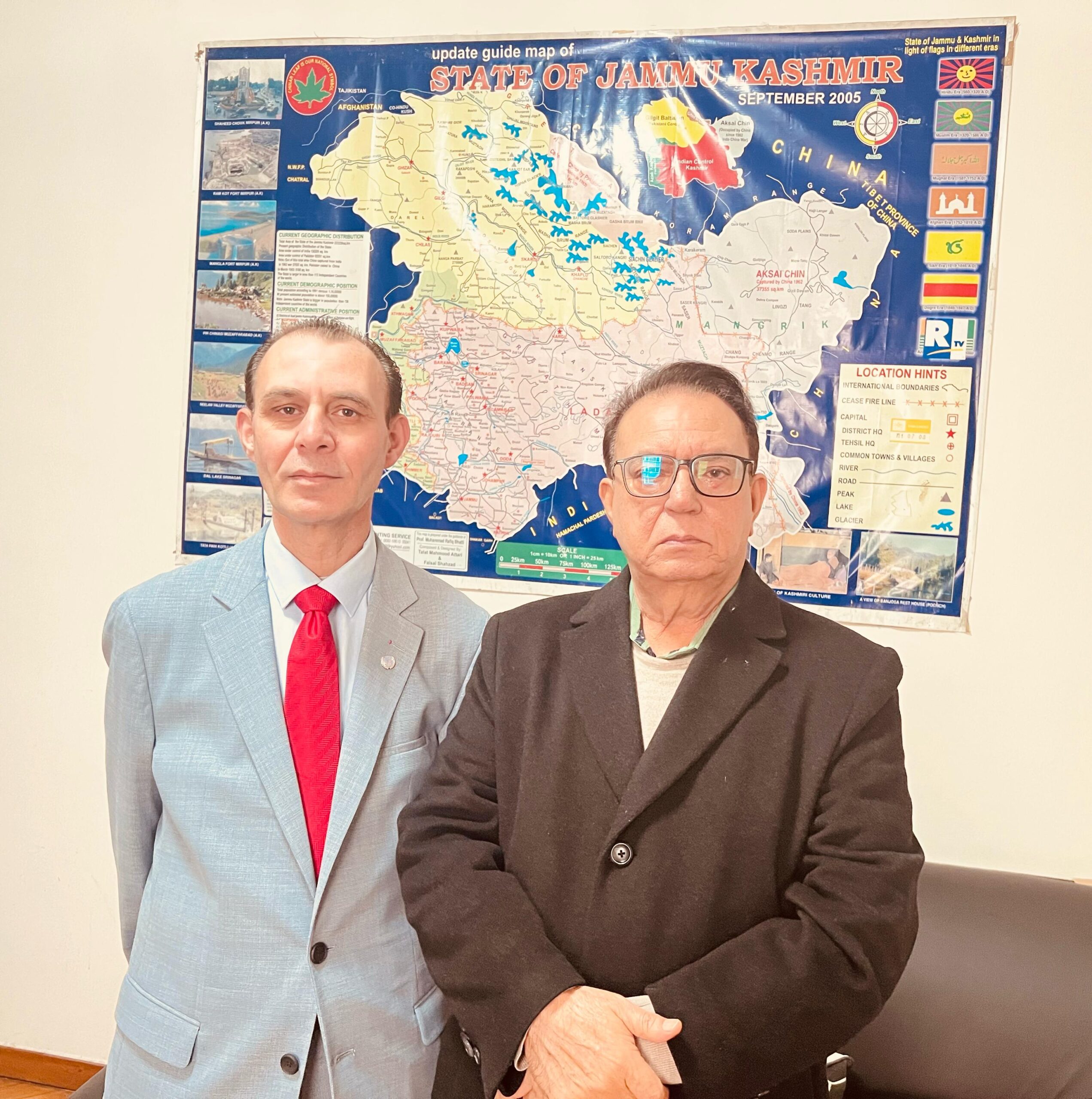
Jammu & Kashmir is of great strategic, cultural, and historical importance. The region has
been at the heart of a territorial dispute between India, Pakistan, and China for over seventy
years. The region is divided into Indian-administered Jammu & Kashmir and Pakistan-
administered Azad Jammu & Kashmir (AJK) and Gilgit-Baltistan. Despite the differing
administrative structures, human rights violations persist throughout the entire region,
particularly in AJK and Gilgit-Baltistan, where the people continue to face political
subjugation and the denial of their basic freedoms.
Azad Jammu & Kashmir (AJK) is often portrayed by Pakistan as an autonomous region.
However, in reality, the region remains under significant influence from the central
government, particularly through military involvement in its political and administrative
affairs. AJK is not an independent entity but is effectively controlled by Pakistan, which
undermines its autonomy.
Although the people of Azad Jammu & Kashmir (AJK) are identify as Pakistani citizens by
Islamabad, they are denied meaningful political representation. Notably, they are excluded
from Pakistan’s National Assembly, which violates Article 25 of the International Covenant
on Civil and Political Rights (ICCPR), guaranteeing equality before the law and protection
from discrimination. This denial of political representation perpetuates disenfranchisement
and marginalization for the people of AJK.
Furthermore, the Vienna Declaration (Paragraph 2) underscores self-determination as a
fundamental human right. Yet, the people of AJK continue to be deprived of the freedom to
determine their political future. Despite Pakistan’s claims of autonomy for the region, no
clear path to independence or full autonomy exists. The absence of a transparent and fair
process, such as a referendum, to allow the people of AJK to express their political aspirations
undermines their right to self-determination, as guaranteed in Article 1 of the ICCPR. By
denying them the opportunity to decide their political future, Pakistan is violating their
fundamental human rights.
This lack of political freedom is further compounded by a repressive environment where
those advocating for greater autonomy, self-determination, or independence face arbitrary
detention, harassment, and even violence. The government’s crackdown on political dissent
violates Article 19 of the ICCPR, which guarantees the right to hold opinions without
interference and to seek, receive, and impart information through any medium. These
restrictions stifle political discourse and suppress peaceful opposition, further entrenching
the political marginalization of the people of Pakistani-administered Azad Jammu &
Kashmir.
The situation in Gilgit-Baltistan is even more severe than in Azad Jammu & Kashmir (AJK).
Despite its strategic importance, particularly in relation to the China-Pakistan Economic
Corridor (CPEC), the people of Gilgit-Baltistan have been systematically denied their right
to self-determination. The region is governed by executive orders, and there are no
2
A/HRC/58/NGO/120
democratic structures to ensure meaningful local representation. Consequently, the people of
Gilgit-Baltistan remain excluded from Pakistan’s political processes, with no voice in
decisions affecting their lives. This exclusion violates Article 1 of the ICCPR, which affirms
the right of peoples to determine their political status and pursue economic, social, and
cultural development.
The absence of political representation and self-determination in Gilgit-Baltistan constitutes
an ongoing violation of international law. The Vienna Declaration (Paragraph 1) emphasizes
that all peoples should have the right to freely determine their political future. By denying
the people of Gilgit-Baltistan this right and continuing to govern the region through executive
decrees, Pakistan is contravening their rights under the ICCPR.
Furthermore, the suppression of political expression and the targeting of activists in Gilgit-
Baltistan reflect a situation similar to that in AJK. Political leaders and activists advocating
for greater autonomy or independence face arbitrary detention, threats, and violence. This
repression violates the right to peaceful assembly, as guaranteed by Article 21 of the ICCPR.
The absence of political freedoms in Gilgit-Baltistan stifles the development of a democratic
society and entrenches political oppression in the region.
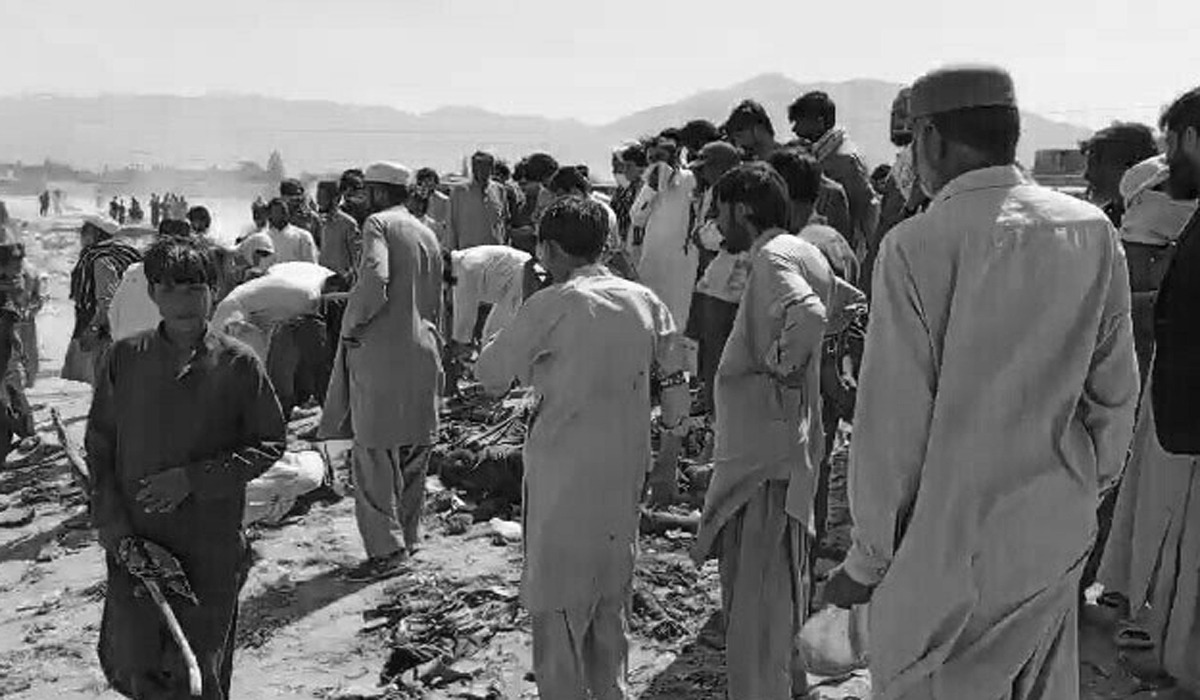
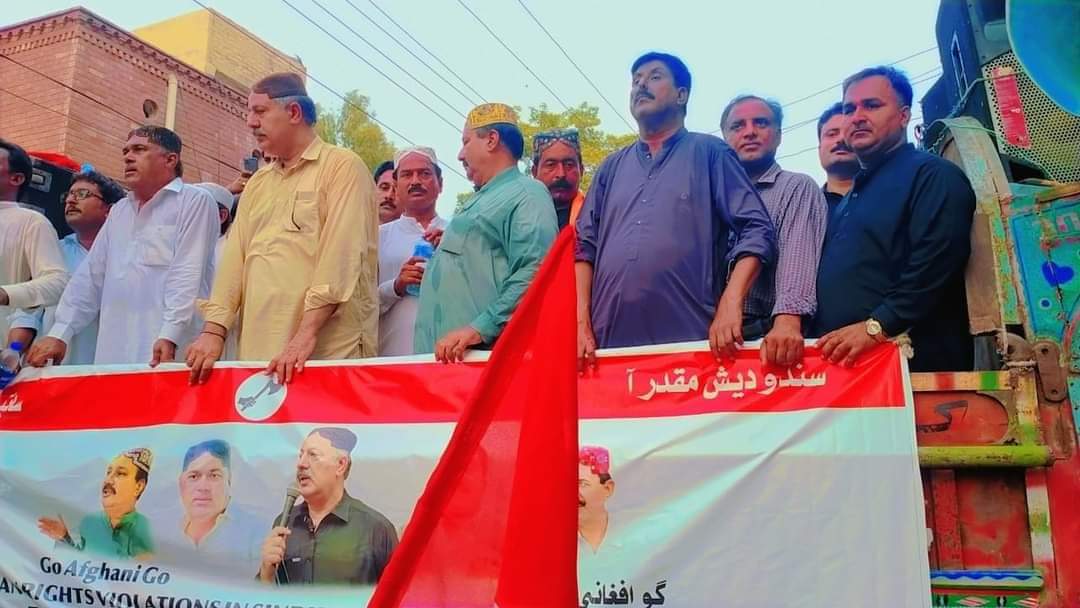
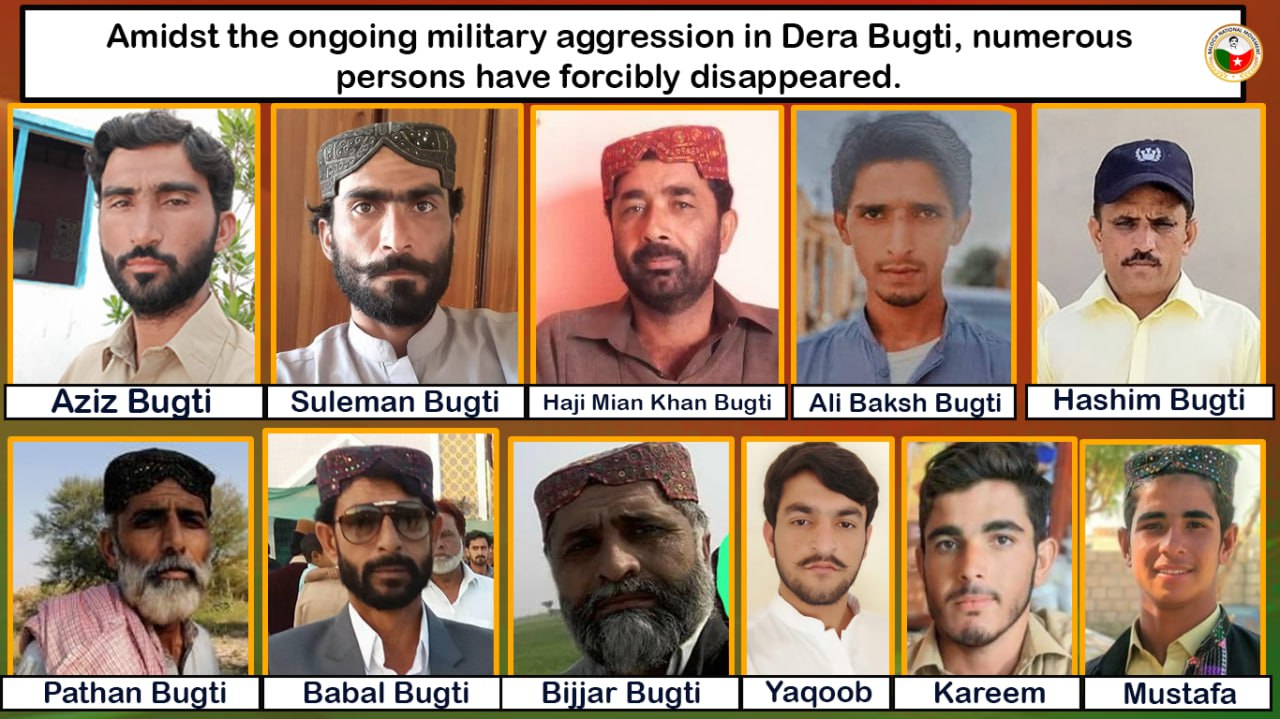
In both Azad Jammu & Kashmir and Gilgit-Baltistan, the military’s presence in civilian life
has resulted in widespread human rights violations. The military often uses excessive force
against peaceful protesters, leading to extrajudicial killings, enforced disappearances,
arbitrary detention, and torture. These actions violate Article 6 of the ICCPR, which protects
the right to life, and Article 7, which prohibits torture and cruel, inhuman, or degrading
treatment. The heavy-handed response to peaceful dissent in both regions clearly breaches
international human rights standards.
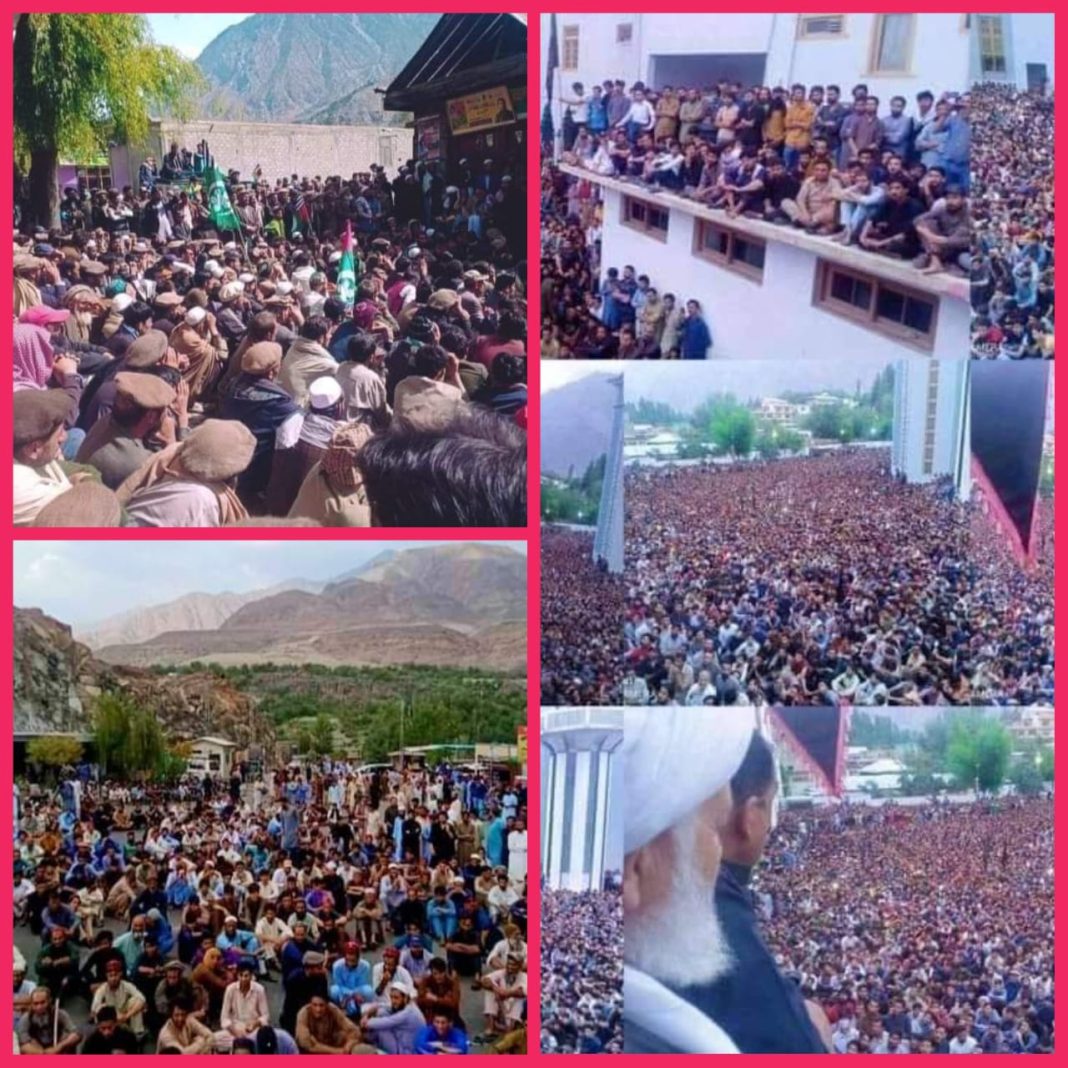
In Gilgit-Baltistan, the situation is particularly alarming for the Shia Muslim community,
which faces systematic discrimination, sectarian violence, and religious intolerance.
Extremist groups, allegedly linked to Pakistan’s military establishment, have targeted the Shia
population with violence and terror. These attacks violate Article 27 of the ICCPR, which
guarantees the rights of minorities to enjoy their culture, practice their religion, and speak
their language. The failure of Pakistani authorities to protect the Shia community and ensure
justice for victims is a serious breach of the fundamental rights of religious minorities.
Another critical issue affecting both regions is economic exploitation. Both territories possess
vast natural resources, but these resources are often extracted for the benefit of external
actors, with little or no benefit to local populations. In Gilgit-Baltistan, the China-Pakistan
Economic Corridor (CPEC) has exacerbated this exploitation, leaving local communities
marginalized and underdeveloped. The extraction of natural resources in both regions
violates Article 1 of the ICCPR, which guarantees the right of peoples to freely dispose of
their natural resources in accordance with their development needs. This exploitation
perpetuates poverty, worsening the already precarious human rights situation in both regions.
The United Nations must take urgent steps to enforce its resolutions on Jammu & Kashmir,
which have long called for a free and fair referendum to allow the people of these regions to
determine their political future, in accordance with Article 1 of the ICCPR. Diplomatic efforts
must focus on ensuring that the fundamental rights and freedoms of the people of AJK and
Gilgit-Baltistan are safeguarded, including the right to self-determination, the protection of
political freedoms, and the safeguarding of civil liberties.
The failure of the international community to address these ongoing violations represents a
significant breach of the commitments made in the Vienna Declaration and the ICCPR. The
continued denial of self-determination, political freedoms, and fundamental human rights to
the people of Azad Jammu & Kashmir and Gilgit-Baltistan cannot be justified. Immediate
and robust action is required to hold accountable those responsible for these violations.
3
A/HRC/58/NGO/120
The Vienna Declaration and Programme of Action, the following international conventions
and frameworks are crucial for the protection of the rights of the people of Jammu & Kashmir
in general and particularly for the people of Azad Jammu & Kashmir and Gilgit.
International Covenant on Civil and Political Rights (ICCPR) International Covenant on
Economic, Social and Cultural Rights (ICESCR) Convention Against Torture and Other
Cruel, Inhuman, or Degrading Treatment or Punishment (CAT) Convention on the
Elimination of All Forms of Racial Discrimination (CERD) Convention on the Elimination
of All Forms of Discrimination against Women (CEDAW) Convention on the Rights of the
Child (CRC) International Convention on the Protection of the Rights of All Migrant
Workers and Members of Their Families (ICMW) Declaration on the Right to Development.
The people of Jammu & Kashmir (including Azad Jammu & Kashmir and Gilgit-Baltistan)
are entitled to live in peace, dignity, and freedom. They deserve their fundamental rights,
including the right to self-determination, political freedoms, and the right to live without fear
of persecution. The UN should take immediate action to address the ongoing human rights
violations in these regions, ensuring that the voices of the people are heard and respected.
CDP urges the United Nations to take note of these violations and hold both India and
Pakistan accountable for safeguarding the rights of the people and fulfilling their international
obligations. The UN must demand that both nations take immediate steps to protect the
fundamental freedoms of the people in Jammu & Kashmir, Azad Jammu & Kashmir, and
Gilgit-Baltistan, thereby upholding the principles of justice and human dignity.
Jamil Maqsood Additional Representative