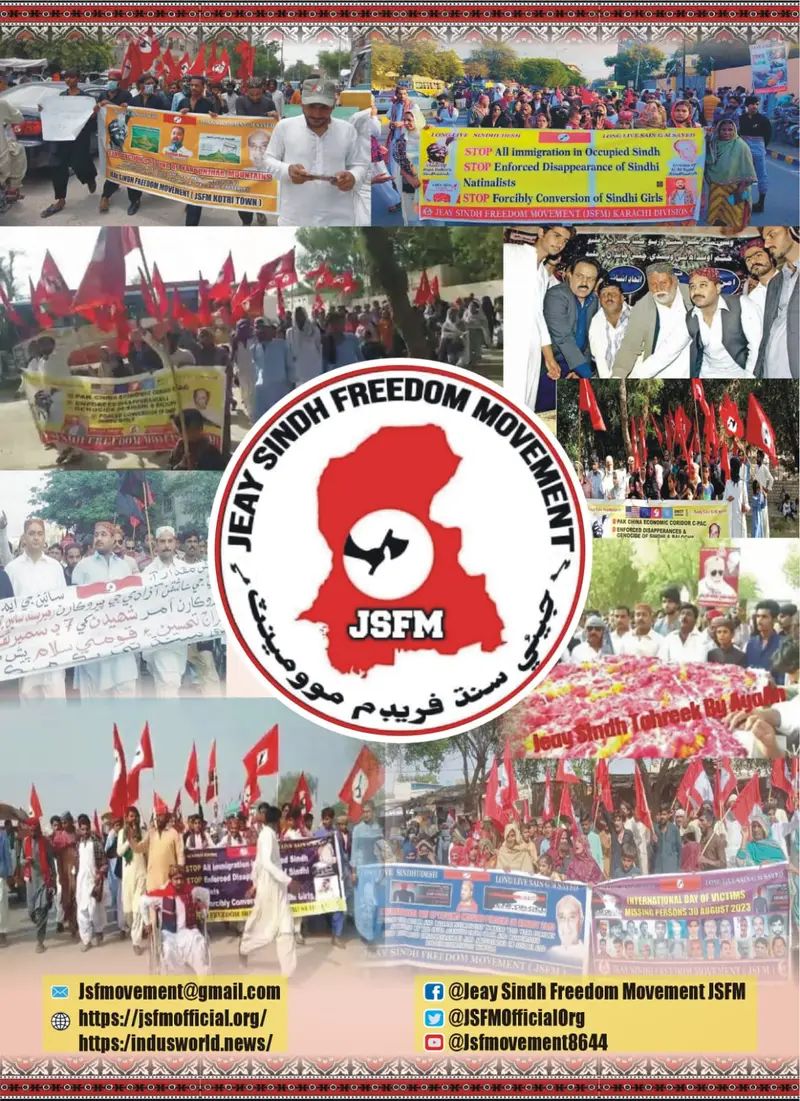

Your Honor! For three-quarters of a century now, I have struggled for the emancipation of my oppressed people who live in these parts of South Asia. All this while, I have earned the ire of rulers who have usurped power.
On numerous occasions I have been under house arrest or in jail during the best years of my life. Whenever I have tried to raise my voice against the vandalization of Sindh, my Motherland, I have been jailed.
Several attempts have been made on my life. I have never once been allowed to state my case in any court of law and to speak on the subjugation of my people.
This is the first time that I have been given an opportunity to speak on my land’s laments. I wish to tell this court and through it to all humanity, especially the thinking people who are living in the closing years of the 20th century, the atrocities that have been committed against my Motherland, Sindh, by ruthless occupying nations.
I want to do so also in order to tell my people, its intellectuals, how a nation which has given the lead to all peoples of the world in the fields of art and culture is now being brutalized and held captive by force and fraud. There are people in this land who are under the influence of migrant feudalistic from India and are proudly touting subjugation as the panacea for Sindh’s problems. Among our many misfortunes is the fact that some of our compatriots hate independence and love enslavement.
At this juncture, representing the spirit of Sindh, I repudiate these elements. If I don’t do so, I shall be considered to have violated the sanctity of the spirit of independence for Sindh. I wish to state here, Your Honor, that Sindh is a distinct geographic entity where there are rivers, forests, lakes, mountains, deserts and verdant valleys. Through the ages it has been expanding and contracting.
It has been independent and enslaved during various stages of its history but, at the same time, it has always had a pure and proud soul that has never accepted slavery or indignity. It has never surrendered to death despite the fact that attempts have been made to bond or break it. This spirit has flitted around Sindh like monsoon clouds as the last voice of the Dravidians of Mohen-jo-Daro.
It has emerged from time to time sometimes in the shape of Raja Dahir, sometimes in the person of Dodo Soomro, sometimes in the shape of Darya Khan and Makhdoom Bilawal and Shah Hyder Sannai. It has expressed itself in the love and courage of Shah Inayat, I feel that these historic persons of Sindh have become part and parcel of my being which would like to reach a logical end now.
Without doubt, it is Sindh’s geographic, national, political, economic, cultural and moral beauty which is the ingredients of its independence. It is this throbbing spirit which has forced me since early childhood to strive for the emancipation of Sindh and its people. Whatever shape my political struggle has taken in South Asia, it has had but one focal point- “independence for Sindh”.
All that which I will now state about my political endeavors should be seen in the light of the submissions I have just made. Your Honor! I completed my early education in Sindhi in 1915 when the First World War was at its peak. When I took to studying English and Persian, I began to see the world in a new light.
I came to realize that the world was facing four major problems – poverty, illiteracy, lawlessness and fear Philosophers, intellectuals and men of wisdom have been trying to solve these problems down the ages.
When pondered over these problems, I came to realize that they were rooted in these factors: Colonialism, feudalism and capitalism caused poverty; Nomadic life and lack of civic and educational facilities together with high cost of education caused illiteracy; And the bloody and barbaric World War on the international level and disorderly life, superstition and blind faith together with threats from wild animals, thieves and marauding raiders at the local levels produced fear and lawlessness.
As I have said, this was the time when the First World War was at its height. Human life had become cheaper than animal life and thousands of innocent people were being killed. In war, the brave man is he who has killed more people than the others. We, the people of Sindh, had by that time been forcibly made part of British India and had become slaves of the British.
The Indians were used as gun fodder. The British had made several promises to the people of the sub-continent in return for their cooperation in the war effort. Among these, the most important pledge was that all British colonies, including India, would be freed.
The Muslims were assured that despite the fact that Britain was at war with Turkey, their holy places would not be desecrated, and the Muslim lands would be set free. The First World War ended in 1918.